RotisFont superfamily; humanist sans-serifVariationsRotis serifRotis semi-serifRotis semi-sansrotis sansShown hereRotis semi-sansRotis is a developed in 1988 by, a graphic designer and typographer. In Rotis, Aicher explores an attempt at maximum legibility through a highly unified yet varied typeface family that ranges from full serif, glyphic, and sans-serif. The four basic Rotis variants are:. Rotis serif (antiqua) — with full. Rotis semi-serif (semi-antiqua) — with hinted serifs. Rotis semi-sans (semi-grotesque) — with zero serifs but with stroke width variation. Rotis sans (lineale humanist sans-serif) — with zero serifs and with minimal variation on stroke width.
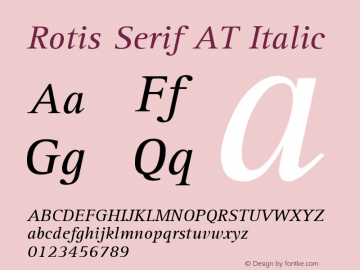
Contents.Monotype Originals Rotis versions When the Rotis fonts were reissued under the Monotype Originals label, the fonts support include support of ISO Adobe 2 character set, OpenType features. The Rotis font names are capitalized.Rotis Serif It includes 55 Roman, 56 Italic, 65 Bold fonts.Rotis Semi Sans It includes 45 Light, 46 Light Italic, 55 Roman, 56 Italic, 65 Bold, 75 Extra Bold fonts.Rotis Pro It includes support of ISO Adobe 2, Adobe CE, Latin Extended characters. In addition, separate fonts for Greek and Cyrillic characters were also created. Greek and Cyrillic fonts support ISO Adobe 2 and Latin Extended characters, and support super/sub-script OpenType feature.Rotis II Sans (2011). Rotis sans-serifIt is a version of Rotis Sans designed by Monotype Imaging senior designer Robin Nicholas, and freelance designer Alice Savoie.
Rotis Serif 65 Bold And Black
It expands the original with extra three font weights (Light, Semi Bold, and Black) and italics, along with revised letter spacing and kerning, a new set of numerals with similar height to the capitals.The family includes 14 fonts in seven weights, with complementary italics. OpenType features include access all alternates, case-sensitive forms, numerators/denominators, fractions, standard ligatures, localized forms (OpenType Pro fonts only), proportional/tabular figures, scientific inferiors, superscript/subscript, stylistic alternates, stylistic sets 1, 2 and 3 (OpenType Std fonts only). It supports ISO Adobe 2, Adobe CE, Latin Extended characters (OpenType Pro fonts only).Naming convention The typeface is named after Rotis, a hamlet belonging to the German town of, where Otl Aicher lived. However, Aicher named the font 'rotis', in, since Aicher thought of as a sign of hierarchy and oppression.When the fonts were reissued by Monotype Imaging in 2011, though, the font names were capitalized to 'Rotis'.
This also affected fonts published by downstream foundries.Uses. Two Twelve Harakawa Inc.; Maestri Design Inc.; Jon Bentz Design (September 2004). System-Wide Signage Design Manual, Second Edition. Archived from (PDF) on June 13, 2010. Retrieved October 18, 2014.
2012-03-14 at the. Spiekermann & Hoefler; Bierut. Design Observer. Retrieved 6 November 2014. Spiekermann, Erik.
Retrieved 23 November 2015. Blackwell, Lewis. 20th Century Type. Yale University Press: 2004.


Fiedl, Frederich, Nicholas Ott and Bernard Stein. Typography: An Encyclopedic Survey of Type Design and Techniques Through History. Black Dog & Leventhal: 1998. Crash and burn 3do iso. Macmillan, Neil. An A–Z of Type Designers. Yale University Press: 2006.External links Wikimedia Commons has media related to. Robin Kinross and Erik Spiekermann on rotis.
Latest from the WhatFontIsHelp your fellow font-seekers if you think you can recognize the font. Earn some good karma by doing it:-)Yet sometimes the images are very complex, so other users need a bit of help.If you recognize the font from the samples posted here don't be shy and help a fellow designer.Thousands of designers (famous or not) use the image font detection system to find a font or similar free fonts from an image. Although we have the largest database of fonts, the search for a font from an image gets mixed results like the image above.