- Apple Prores 422 Codec Mac Premiere Download
- Apple Prores 422 Hq
- Export Apple Prores 422 Premiere Pro Cc Windows
Well, there are lots of codec choices and format options in Pr that would potential satisfy any delivery requirement-but we really don't know what your delivery requirement is. I suggested DNxHD, because doughnuts-to-doughnuts, it's pretty similar in quality and function to ProRes; the compression type they both use is the same.
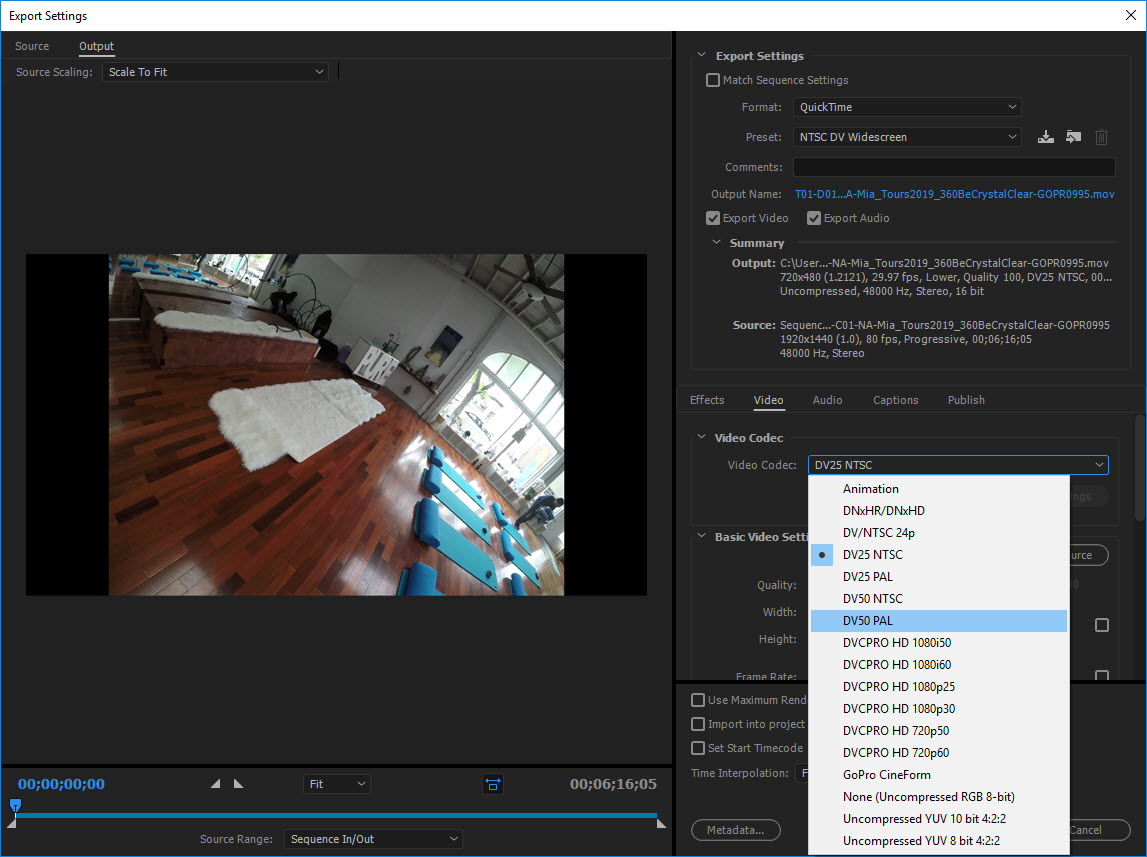
They both provide a large, high-quality, able-to-be-edited, suitable-for-broadcast, ready-for-archive video file.That said, if they don't need to edit the file, or archive it, or are going to be recompressing the file for broadcasting (through some sort of play-out server), then there are other high-quality options you might potential use that are already available in Pr, don't require a codec download and installation, and will create much smaller delivery files. One clear option in this regard would be to use H.264 as the codec; this is either available by selecting H.264 as the Format (which creates an MP4 and has quite a few configurable options) or by selecting QuickTime as the Format (this creates an MOV, but isn't quite as configurable). I actually do most of my broadcast delivery with the QuickTime H.264 option, and I'm on a PC.I guess the bottom line is that you need to check with the recepient what their needs really are, and if they are flexible on format.Hope that doesn't confuse too much! Im no dessert expert, but I think the phrase might be 'dollars to doughnuts'.Dollars to donuts is a faux bet in which one person agrees to put up the same amount of to another person's in a (where a donut is considered to be worth much less than a dollar). Betting someone dollars to donuts is a that indicates that the person is confident in the outcome of an event, but it does not usually involve an actual bet with actual payoffs (either in dollars or in donuts).Or, to quote Homer Simpson.' Hi, my belief is that the Prores mainly stems from most of their suppliers being mac based and that was also the way their tech support staff lead the way.
I have assumed they wanted a format which would allow for re editing etc by themselves. The written specs for SD are Quicktime DV25/50 and HD Prores 422 1920.1080, square pixel, Upper Field Dominent. There's actually no other option detailed and I want to create a demo to show them what PP on a PC is capable of in order to provide HD as well as SD editsI've used H264 for my own use (eg streaming to a HD TV) and found it gives very good results in handleable files, but was interested in what others recommended etcMany thanks. PmPhotographic, the exact request was phrased as a question by the broadcaster, as they knew that at that time I was editing using Vegas Pro.
'Can you export as Apple ProRes 422 (HQ)?' Other editiors had suggested DNxHD, so I gave it a try, and it worked a treat, though rendering time was slow on my dual core PC.The broadcaster was happy with it, and didn't mind having to install the codec on their Apple Macs. I guess it was just another tool in their armoury of editing tools. And one they didn't have to pay for.
Hi and thanks again, Shooternz. I'm a Mac owner, but I do work freelance on Windows systems, and have associates who are on Windows. So, no I downloaded the Mac version.I was a little behind on my research, and after Googling, it appears that there are a few options now for making ProRes on Windows.
Among them appears to be a Telestream product called Vantage.BTW, one of the great advantages of ProRes over DNxHD, esp. For compositing apps, is that there aren't any frame size or rate restrictions on ProRes, as there are with DNxHD, which is quite persnickety about them. DNx won't let you make pre-renders that are 10x1000 at 8 FPS, for example, but ProRes has no problems with that kind of thing.
DNxHD or DNxHR are one of the closest Prores equivalent export codecs in windows Adobe Premiere. If you are exporting for broadcast/ for a mac system, these.MXF formats are usually the most compatible. It's an AVID codec so any decent editor set up on a mac (or Linux) should have these installed on their machine already (if they are not already installed with edit software).Third party encoders to wrap file in prores format can work - but take extra time to encode. IMHO Makes much more sense to use.MXF format if on windows machine for delivery format.and.h264 for offline proxies/ viewing copies etc.
DNxHD or DNxHR are one of the closest Prores equivalent export codecs in windows Adobe Premiere. If you are exporting for broadcast/ for a mac system, these.MXF formats are usually the most compatible. It's an AVID codec so any decent editor set up on a mac (or Linux) should have these installed on their machine already (if they are not already installed with edit software).Third party encoders to wrap file in prores format can work - but take extra time to encode. IMHO Makes much more sense to use.MXF format if on windows machine for delivery format.and.h264 for offline proxies/ viewing copies etc.thx! I wonder if vimeo is compatible with dnxhd?
That would be a god send. I need to preserve as much film grain as possible. H.264 compresses the hell out of it. I wonder if vimeo is compatible with dnxhd? That would be a god send.
I need to preserve as much film grain as possible. H.264 compresses the hell out of ithmmm good tipMXF is not officially supported. There are some reports that it can work but not that great.You can use DNxHD with.mov wrapper through premiere that I believe is supported with Vimeo.Cineform is also as good as prores and there has been some talk of vimeo trying to support it. I am not sure but you can try.What I would do is use the smallest sequence that vimeo allows and use different codecs:1. High bitrate h264 (40) with a.mp4 wrapper.2.
Export to uncompress AVI and then use a trancoding tool for prores.3. DNxHD with.mov (not mxf).4. Cineform 10bit YUV. See if it is supported.1,3,4 can be done in premiere.Check to see which one is best for you after uploading, and if 2 is worth the extra time. MXF is not officially supported. There are some reports that it can work but not that great.You can use DNxHD with.mov wrapper through premiere that I believe is supported with Vimeo.Cineform is also as good as prores and there has been some talk of vimeo trying to support it. I am not sure but you can try.What I would do is use the smallest sequence that vimeo allows and use different codecs:1.
High bitrate h264 (40) with a.mp4 wrapper.2. Export to uncompress AVI and then use a trancoding tool for prores.3. DNxHD with.mov (not mxf).4. Cineform 10bit YUV. See if it is supported.1,3,4 can be done in premiere.Check to see which one is best for you after uploading, and if 2 is worth the extra time.i'll try out the cineform, I really REALLY appreciate the tip.
Apple Prores 422 Codec Mac Premiere Download
I once heard on the net that cineform is about to be the new standard for mastering footage. Something about it being close to how they scan film?
Apple Prores 422 Hq
Not sure but I hear its really really good! Will report back with results. Think you may be confusing Cineform with Cineon format?Cineform is now owned by GoPro (make of that what you will)In a nutshell Prores and DNxHD are most common formats for TV broadcast 'masters' (at least for here in the UK) - often they also require a compressed SD MPEG version for compliance.if you have the storage space, you could use whatever format you want to master in. But since you are on PC - you could export uncompressed.Avi as a master format as aaronchicago mentioned, this is how I used to do it- then spit out any compressed flavour of file from that file using AME. Find the best balance of file size vs quality for uploading or sharing. This may be Cineform, DNxHD whatever.but you will quickly find what works (regarding file size limits for upload).I can personally recommend 10 or 8bit DNxHD masters for cross platform compatibility (Mac/pc playback) - as well as being compatible for uploading to Vimeo (as also previously stated in.mov wrapper). File sizes can be reduced to impressive amounts for the visual quality of the file.
It is fair to say it is one of the closest formats to Prores on a PC.as it is so easy to select different quality settings (that are very similar to the prores presets) and without the ball ache of installing additional codecs if you ever needed the deliverable master file to be sent to a Mac based editor or broadcaster. I once heard on the net that cineform is about to be the new standard for mastering footage. Something about it being close to how they scan film? Not sure but I hear its really really good!Could be mixup somewhere but if you heard it had anything to do with a film scan or being a 'standard' for mastering footage.It sounds more like the Cineon format to me:The.dpx offshoot format is still fairly commonly used for bringing in film scans, especially for visual effects and restoration work.
Then those digital files can be outputted back to film or (more commonly now) kept in the digital realm for post production.I have many old.dpx Cineon files of 35mm scans - from effects footage taken from the early 2000's. These.dpx files were usually 2k scans open gate - and considered the 'digital negative' or 'Master' (because they contain log data comparable to raw, but from film scan acquisition).Cineform is now the new standard for GoPro lol. Could be mixup somewhere but if you heard it had anything to do with a film scan or being a 'standard' for mastering footage.It sounds more like the Cineon format to me:The.dpx offshoot format is still fairly commonly used for bringing in film scans, especially for visual effects and restoration work. Then those digital files can be outputted back to film or (more commonly now) kept in the digital realm for post production.I have many old.dpx Cineon files of 35mm scans - from effects footage taken from the early 2000's. These.dpx files were usually 2k scans open gate - and considered the 'digital negative' or 'Master' (because they contain log data comparable to raw, but from film scan acquisition).Cineform is now the new standard for GoPro lol.that could be it, seems likely. Cineform is now the new standard for GoPro lol.Cineform is now the new open standard for video acquisition and post production.
Export Apple Prores 422 Premiere Pro Cc Windows
Its not restricted by resolution, accepts multiple wrappers and supports 3D and RAW. It is much better supported across platforms (windows specifically) and it offers very efficient compressions.At least in my tests transcoding to cineform gave much better results than prores which has to use a non native algorithm under Windows because of Apples decision not to allow it.So yeah f.ck prores. Cineform is now the new open standard for video acquisition and post production. Its not restricted by resolution, accepts multiple wrappers and supports 3D and RAW.
It is much better supported across platforms (windows specifically) and it offers very efficient compressions.At least in my tests transcoding to cineform gave much better results than prores which has to use a non native algorithm under Windows because of Apples decision not to allow it.So yeah f.ck prores.Damn sounds promising!! You can export ProRes from Premiere on a Windows PCi use this for any jobs or festivals that demand ProRes delivery and it works. It's the only way I know that doesn't involve coding ffmpeg.no point installing the DNxHD component from it, use Avid's.when I'm not using it I tend to uninstall it as it sometimes causes import issues for certain Quicktimes. It's good when you're in a bind though.i never use it unless I have to because of someone else.Unfortunately it looks like you can't buy that product from Miraizon any more as they say that 'their sales have now ended'.